
Frequently Asked Questions
Our FAQ
In our FAQ we answer frequently asked questions about GESI, our sites, safety and the project process. Clear and transparent, so that you can form your own picture.

What advantages do large-scale battery storage systems offer?
Large-scale batteries stabilise the power grid and ensure that solar and wind farms have to be curtailed or even shut down less often. In the event of grid imbalances, GESI Giga Batteries can quickly help grid operators and stabilise the grid frequency within seconds. This is important to ensure a continuous energy supply.
What does this mean for the electricity price?
Large-scale batteries ensure that more electricity is available and that flexibility on the electricity market increases. In this way the most expensive providers, for example gas-fired power plants, are pushed out of the market. As a result, the wholesale electricity price also falls. According to studies, the expansion of battery storage can reduce the electricity price by 6 to 7 percent and, in particular, reduce price peaks.
How does the business model work?
Operators buy green electricity and store it when it is abundant and therefore cheap. When it is needed again and the price is therefore higher, they sell the electricity again. The average size of this difference can be forecast and calculated well.
Which battery technologies are most common at the moment?
In the stationary storage market, lithium-ion (Li-ion) batteries are currently the dominant technology. For some years now the trend in this area has been clearly towards lithium iron phosphate (LFP). The competing nickel-manganese-cobalt technology does have advantages in terms of longevity and energy density, but the disadvantages in terms of cost, safety and critical raw materials outweigh them.
Which alternative battery technologies are there?
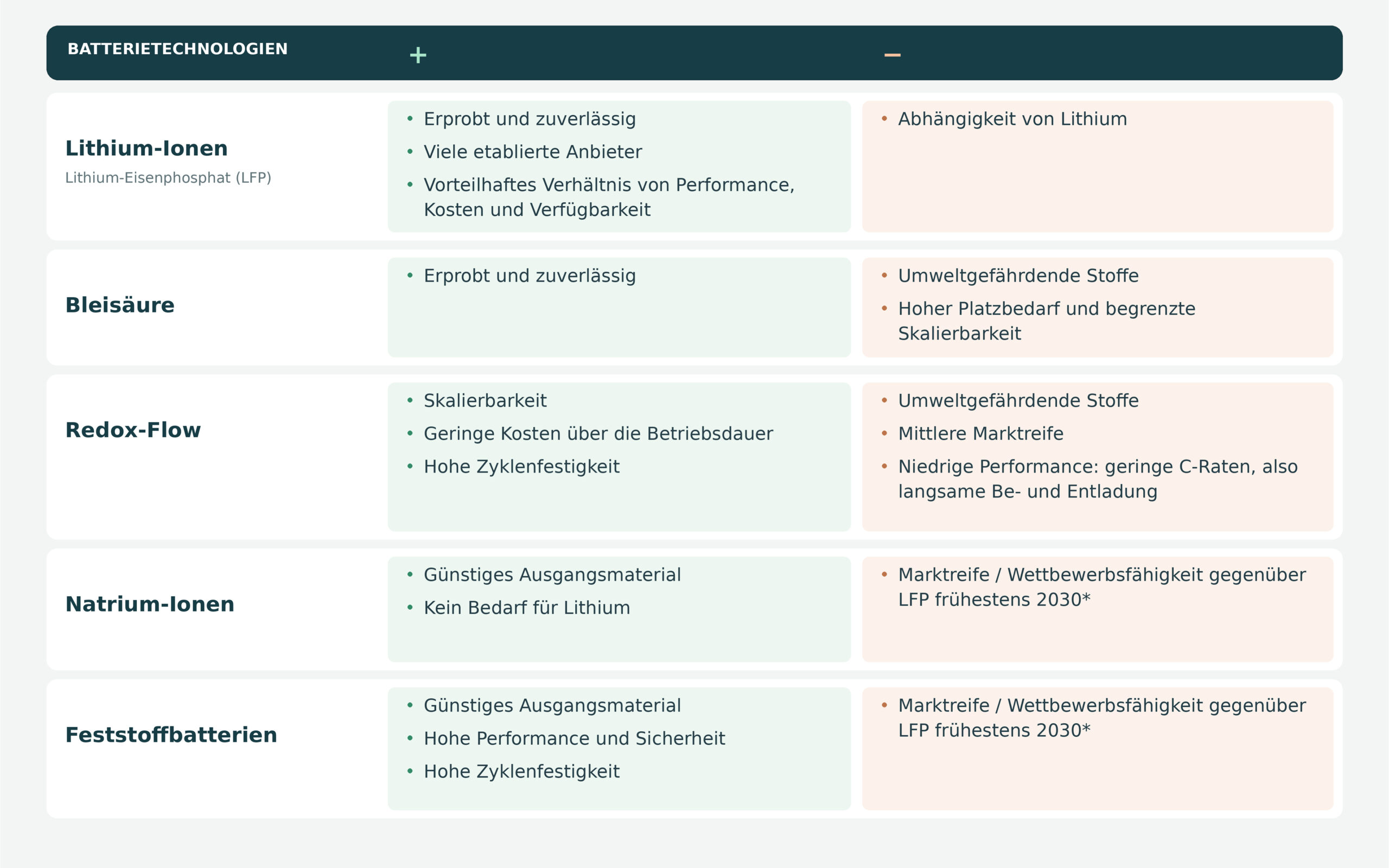
Some providers promote technologies such as redox flow, sodium-ion and solid-state batteries. In the short and medium term, however, experts see no serious or credible alternative to lithium-ion technology. Key problems include low power densities and therefore a lack of flexibility. The advantages and disadvantages at a glance:
What are the lithium iron phosphate batteries used by GESI made of?
The main components are iron (Fe) as the cathode material, phosphorus (P) – also in the cathode – and lithium (Li) as part of the electrolyte. Our batteries are therefore based exclusively on natural raw materials and contain no environmentally harmful acids or conflict minerals such as cobalt. In a study funded by the Federal Ministry for Economic Affairs, the Association for Electrical, Electronic and Information Technologies (VDE) classifies LFP as non-toxic and harmless.
How long do the GESI Giga Batteries last? How high is the fire risk?
LFP batteries withstand up to ten times as many charge cycles as conventional lithium-ion batteries. They are also insensitive to full charging, which offsets the disadvantage of their lower energy density (lithium-ion batteries should ideally only be charged to 80 percent). Accordingly, the fire risk is significantly lower.
Do GESI batteries end up in the trash?
LFP batteries are recycling-friendly because they contain no toxic or rare materials. We therefore integrate them into a recycling concept (a circular economy is currently being established).